



To be honest,Amazon OA 2026 is not as difficult as imagined, and there are not many difficult algorithm questions. But many people are stuck in OA, not because they can’t write, but because they used the wrong idea from the beginning. What Amazon cares more about is: whether there is a stable and reusable basic idea, and whether the correct solution can be written within a limited time. This article will sort out the key test points, problem-solving directions and common pitfalls based on real question types.
Interview Overview | Amazon OA 2026 Overall Process and Question Type Distribution
From the overall structure, Amazon OA 2026 still maintains a very typical style: 70 minutes of two Medium difficulty coding, using Hackerrank.
OA basic information overview
- Form:Online Assessment
- Number of questions: Usually 2 channels
- Question type distribution:
- Algorithm/data structure questions (required)
- SQL / data processing questions (high frequency)
- Simple design or logic questions (leaning on engineering thinking)
- Core inspection points:
- Can the problem be solved using O(n) / O(1) ideas?
- Do you understand how data is processed in real business?
- Do you have the awareness of “updating while maintaining the optimal solution”?
Q1|Subarray & prefix sum: not violence, but "state maintenance"
The essence of the first question is onePrefix sum + status resetThe core of the problem lies in how you judge "when you must operate."
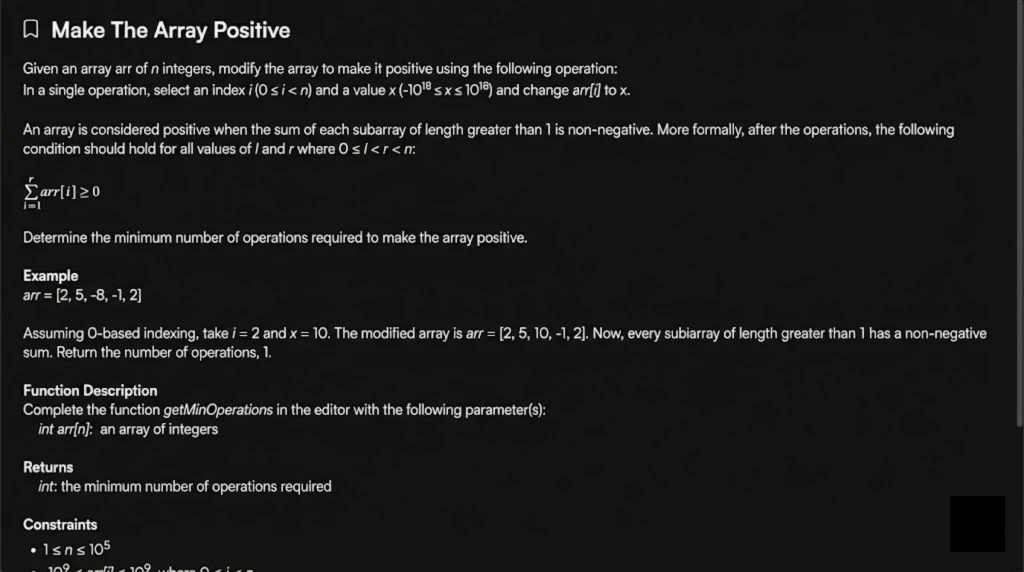
Core idea
When solving this type of problem, you can maintain a current accumulated negative suffix sum. When the prefix sum is positive, it means that it is helpful to subsequent subarrays, so it can be retained. Once it is found that the current cumulative sum + the current element < 0, it means that there is a subarray whose sum is negative. In Amazon OA, this usually corresponds to an "operation" in the question (such as delete / reset / adjust), which requires an immediate reset of the state.
Essentially, this type of question tests whether you understand that prefix sums are tools, not results, and whether they can be used O(n) The scanning method solves the problem instead of using nested loops to enumerate all sub-arrays. If you are still struggling with "where the subarray starts and ends", it is basically already slow. Mastering the ideas of prefix sum and state reset will allow you to quickly and safely find the correct solution in OA.
Q2|Given a one-dimensional array, arr[i] and arr[i+k] can be exchanged each time. Find the minimum number of operations to make the entire array in order.
This question is very obvious about bubble sort. The number of operations of bubble sort is equivalent to the number of reverse-order pairs. The method of counting reverse-order pairs requires merge sort. So the overall operation is to group first and divide them into k groups. Use merge sort to count the reverse-order pairs in each group and sort them. After sorting, restore the elements of each group to the original array to see if they are in non-descending order. If not, there is no solution. Otherwise return the sum of each reversed pair.
In OA and technical interviews at large companies, what matters is not just the number of questions, but on-the-spot judgment and idea selection.
Many people prepare for large-scale factory processes. In fact, it is not because of lack of ability, but because no one can help at key nodes.Programhelp This site has long-term support for OA, technical aspects, VO and other aspects, and is familiar with mainstream platforms and major factory processes, and can help you stabilize your ideas and rhythm at critical moments. Whether it is the code completion in the written test stage or the real-time reactions and expressions in the interview, there are engineers with corresponding backgrounds to participate and support, instead of just leaving it to you to do it yourself.