



This time Barclays My overall feeling about OA is that the time is very long and the information density is very high. If you have not been exposed to similar question types in advance, it is easy to be consumed in the middle and later stages. OA is given a total of 240 minutes, which seems to be plenty of time, but the topic description is long, there are many rules, and the boundaries are complex. After actually doing it, you will find that the time is actually very tight. This is not the kind of process that ends with just a few algorithm questions, but a test that is more of a "complete engineering thinking".
Barclays OA Basics Overview
- Total duration: 240 minutes
- Question type: Coding + Rule Simulation
- Optional languages: Java/C++/Python
- Key inspections: complex rule understanding, status management, and boundary processing capabilities
Barclays OA real question sharing and in-depth analysis
Topic 1: Robot Cleaner
The main idea of the title: Give you a room map (Grid),# It's a wall,. It's an open space,* Is your starting point. You need to write an algorithm to control the robot to move up, down, left, and right, and scan all accessible open spaces in the room.
Notice: The output is not the number of steps, but a complete sequence of movement instructions (such as ">>v<^...").
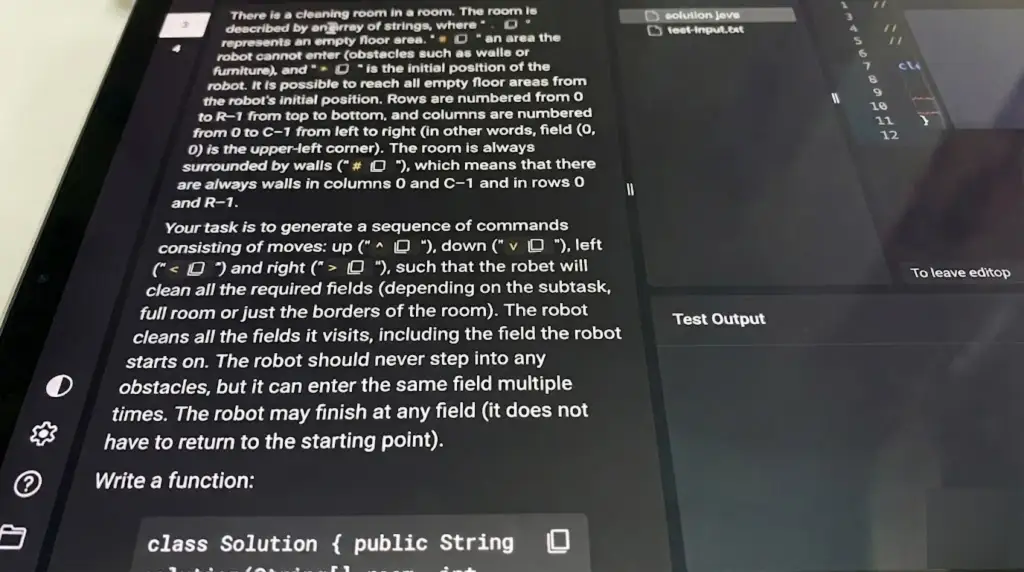
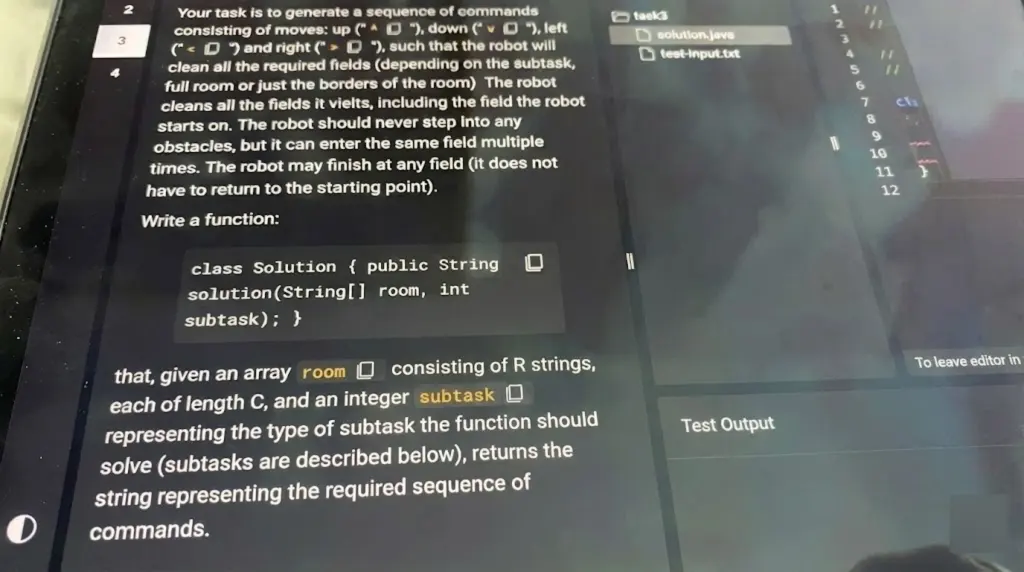
Ideas for solving the problem: This question is not suitable for BFS because the robot cannot jump directly between states and all movements must be executed realistically. A more reasonable way is to use DFS to fully explore the path: choose an unvisited and non-hitting direction at the current location to move forward, and record the corresponding instructions; when it is impossible to continue, return to the previous location by backtracking, and then try other directions.
Topic 2: Minimum Chairs
The main idea of the title: This is much simpler. Give you a string of characters S, representing a bunch of people coming in and out:
'S'(Start) = Someone comes in'E'(End) = One person left. How many people are there at most in the room at the same time? (That is, at least a few chairs need to be prepared).
Ideas for solving the problem: This is a typical simulation question that can be completed with a counter. Traverse the string sequentially and encounter S The counter is incremented by one, and the current historical maximum value is updated after each increment; when E Decrement the counter by one. After the traversal is completed, the maximum value recorded is the answer.
Reference code (Java):
Class Solution {
    public int solution(String S) {
        int maxChairs = 0; // Historical peak value
        int currentPeople = 0; // Current number of people

        for (char event : S.toCharArray()) {
            if (event == 'S') {
                currentPeople++;
                // Only when there are more people do you need to check whether there are enough chairs
                maxChairs = Math.max(maxChairs, currentPeople);
            } else if (event == 'E') {
                currentPeople--;
            }
        }

        return maxChairs;
    }
}
Remote assist experience sharing
In fact, many students' rhythm is easily disrupted in this kind of long-term OA with complex rules. If you want to keep your thinking clear during the exam and grasp the key points of the questions, the remote assistance service provided by Programhelp will be very helpful:
Real-time voice reminder: When you encounter boundaries or rules that are easy to ignore, you will be prompted with the direction of your thinking as soon as possible.
Code assistance: Provide templates and key ideas to help you complete complex simulation questions within a limited time
OA ghostwriting/tutoring: Hands-on throughout the entire process, covering complete guidance from problem analysis to code implementation
VO & interview assistance: Not only OA, but also behavioral/VO interviews can get voice prompts and answer strategies
If you also want to maintain the rhythm in Barclays or other long-term OA with complex rules without being slowed down by details, you might as well try Program assistance Remote assist. Whether it is OA question analysis, code implementation, or VO/Behavioral interview question answering strategies, you can get real-time guidance and voice reminders, so that you can calm down at critical moments and exert your greatest strength.