



I recently helped a student review the test Amazon When students come up, their first reaction is to use DP, thinking of recording the minimum number of steps in each position. But after writing a few lines, I found that the state transfer is too complicated, the time complexity is close to O(n²), and it will definitely time out in the case of large arrays.
Overview of the Amazon SDE interview process structure
The overall interview process for Flax SDE is usually: Resume Screening → Online Assessment → VO → Recruitment Assessment. Note thatAmazon Leadership Principles Not just in behavioral interviews, but throughout assessments from the earliest stages of the process.
In the resume screening stage, in addition to looking at technical background and project experience, the recruiter will also pay attention to whether the candidate embodies LP characteristics such as Ownership and Deliver Results, such as whether he has the experience of being fully responsible for the project and promoting closed-loop issues.
OA usually consists of two parts. The first part is algorithm questions, which focus on high-frequency test points such as arrays, strings, trees, greedy and dynamic programming. The focus is not only on writing correct answers, but also on logical clarity and boundary processing capabilities. The second part is the behavioral or work style test. This module is highly related to the Flax LP. The questions use scenario selection to examine your decision-making tendencies under pressure, conflict and uncertainty, which will often affect the subsequent interviewer's overall judgment of you.
VO typically consists of 3–4 rounds of cross-technical and behavioral interviews. While testing the algorithm, the Coding round will ask about your solution selection and trade-off logic to map relevant leadership principles; the System Design round not only focuses on architectural capabilities, but also asks questions based on past experience to examine long-term thinking and result orientation; at the end, there is usually a round of behavioral interviews that are highly focused on Amazon Leadership Principles, with in-depth questioning of experience details.
In summary, being able to systematically align your experience with the flax LP is key to passing the entire interview process.
Round 1: Algorithm Programming (Coding)
Question 1: Jump Game II (minimum number of jumps)
The first reaction of the trainee was to use DP, thinking of recording the minimum number of steps for each position. However, after writing a few lines, they realized that the state transfer is too complicated, the time complexity is close to O(n²), and it will surely time out in the case of large arrays.
We reminded him to think differently: the key to each step is "where to jump to cover the farthest". So he adjusted to a greedy solution: two variables to maintain the current_end And farthestIn this case, it is a process of traversing the array, constantly updating the furthest reachable position, and jumping once it reaches the current boundary. This process is like the hierarchical traversal of BFS, which is clearer and meets the expectations of the interviewer.
After adjustments, the code was written in a few minutes, with a couple of edge cases along the way, such as when the array length is 1 or when the elements are 0.
Topic II: Binary Tree Cameras (Binary Tree Monitoring)
The difficulty with this problem is the state definition. The trainee only thinks of violent enumeration at first: each node either loads a camera or not, and then recursively counts the minimum number. However, once the recursive tree is expanded, the complexity directly explodes and it is not feasible.
We guided him to think, "Can we define states for each node to reduce double-counting?"
He later used DFS back-order traversal to give nodes in three cases:
- The node is fitted with a camera;
- The node is covered (child nodes have cameras);
- The node is not overwritten.
The traversal prioritizes the child nodes to take on the coverage responsibility and puts the camera at the current node only when necessary. With this turn of thought, it goes from exponential complexity to linear complexity. The interviewer nodded directly after writing it.
Round 2: Algorithmic + Behavioral Hybrid
Coding: Remove K Digits (Remove K Digits for Minimum)
When the trainee sees the question, his intuition is "violently remove all combinations and then take the minimum", but immediately realizes that this is exponential and not feasible at all.
He got stuck for a few seconds, and we hinted that for these "delete elements to make the result smaller" questions, the probability is to use a stack or greedy.
He tries to use a monotonically increasing stack: iterating over the numbers from left to right, and if the current number is smaller than the top of the stack, he keeps popping off the larger number, which ensures that the result is as small as possible.
After writing, we found a pitfall: if K is not used up, we have to continue to delete from the end; and the result has to remove the leading zero, otherwise there will be more cases like "0012". We reminded these two points in advance, and the students corrected them in time and passed successfully.
Behavioral: Flax LP high frequency problem
At first, the students answered that LP was a bit of a "running list". For example, when talking about "projects that make them proud", they only mentioned "creating an automated reporting system." We helped him expand the details: why to do it (background pain points) → how to do it (specific plan) → what are the results (quantitative improvement). This is in line with the STAR framework and makes the story more convincing.
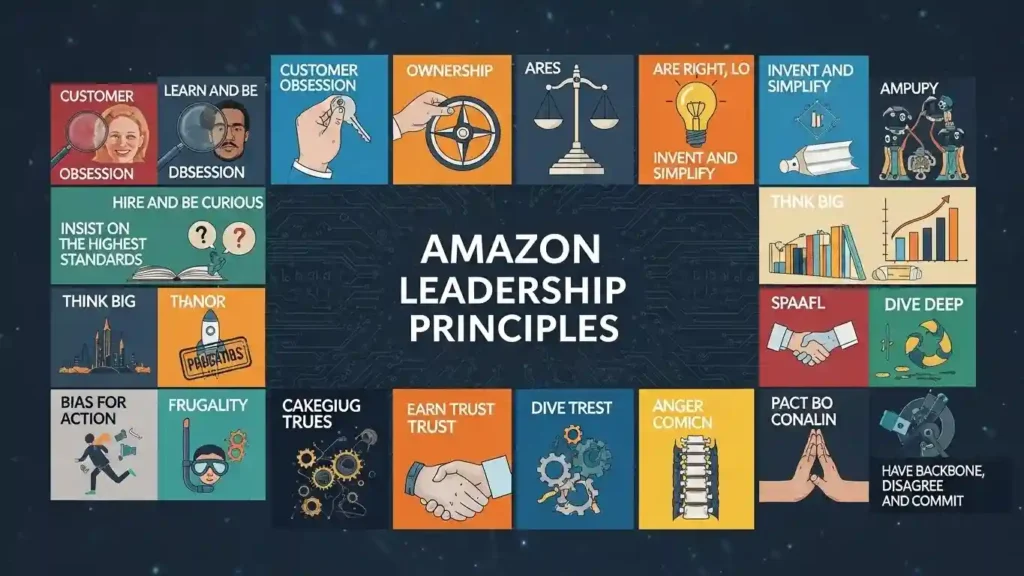
Suggestion list + template example:
| Leadership principles | Typical questions | Answer points |
|---|---|---|
| Customer first | Please give an example of how you seek benefits for your clients | Demonstrate how to prioritize customer needs and actually drive improvement or impact |
| Take the initiative to take responsibility | Please describe a time when you took the initiative to take on work that went above and beyond your responsibilities. | Demonstrate a sense of responsibility by demonstrating experience in proactively taking risks or solving problems |
| Act quickly | Please give an example of a decision you made under time constraints | Emphasis on making reasonable decisions quickly with limited information and bearing the consequences |
| Deliver results | Please share a time when you accomplished a key goal under pressure. | Focus on final results and actual impact, reflecting execution and influence |
FAQ – Amazon Software Development Engineer
Q1: Will Amazon SDE’s algorithm questions be very popular?
A: No, most of them are LeetCode high-frequency questions. The focus is on whether the ideas are clear and whether you can quickly write bug-free code.
Q2: How to prepare for LP behavioral questions?
A: It is recommended to prepare 6~8 STAR cases in advance, covering common scenarios (conflict resolution, efficiency improvement, customer focus, leadership).
Q3: What should I do if the coding process gets stuck?
A: You must dare to exchange ideas with the interviewer and don’t be stubborn. Flax values "communication + iteration" rather than just looking at the final answer.
Q4: Is there an interval between the three rounds of interviews?
A: Usually about a week, the pace is tight.
Contact us immediately and no longer fight alone
Amazon's interview is definitely a "algorithm + LP two-front battle". Anyone who is not prepared can easily fall over.
If you are also preparing for OA/VO from Amazon or other major manufacturers:
We provide OA invisible remote interview, written test assistance, real-time voice reminders for programming questions, no need to worry about getting stuck;
LP story polishing helps you translate your project experience into a STAR framework that interviewers love to hear;
Mock interview accompaniment will help you adapt to the high-pressure scenarios of large companies in advance.
Don't do it alone. With the help of a professional team, you will find that you can "steadily handle" the interview.